
A successful sleeping bag program is not built around the lowest temperature printed on a product title. It starts with climate, end use, verified insulation performance, size, packed volume and the expectations of the sales channel.
That distinction matters when sourcing wholesale sleeping bags for the United States and South America. Both regions contain warm coastal areas, humid forests, high-altitude routes and cold, windy southern zones. A single specification may look convenient, but it can create returns, weak reviews or safety concerns if the temperature claim and construction do not match the user’s real conditions.
For importers, distributors and outdoor brands, the better approach is to define several clear product configurations and document every performance claim before bulk production. The following framework explains what buyers should compare.
EDITOR NOTE – IMAGE 1: Use as the featured image and insert here immediately after the introduction. Remove this note before publishing.
1. Segment the market by climate and activity
Country names alone are not a complete buying brief. The same distributor may sell to thru-hikers, family campers, vehicle-based travelers, outfitters and institutional customers. Each group makes a different trade-off between weight, comfort, durability and price.
United States
In the U.S., backpacking customers commonly compare total weight, packed size, length options and clearly stated temperature performance. Camping retailers may also need broader, more comfort-oriented models for vehicle camping, while colder states and shoulder-season users require a separately verified lower-temperature configuration. Product pages and packaging should normally show both imperial and metric units, with Fahrenheit prominent for consumer-facing temperature information.
South America
South America should be divided into practical climate zones. High-altitude Andean routes can have cold nights and strong day-to-night temperature changes. Patagonia and other southern destinations add wind and moisture. Tropical and coastal markets may prioritize breathability, lighter insulation and fast drying over maximum loft. Spanish-language information is important in many markets, while Brazilian buyers may require Portuguese packaging and care instructions. Metric dimensions and Celsius temperature information should be easy to find.
2. Choose construction and materials for the real use case
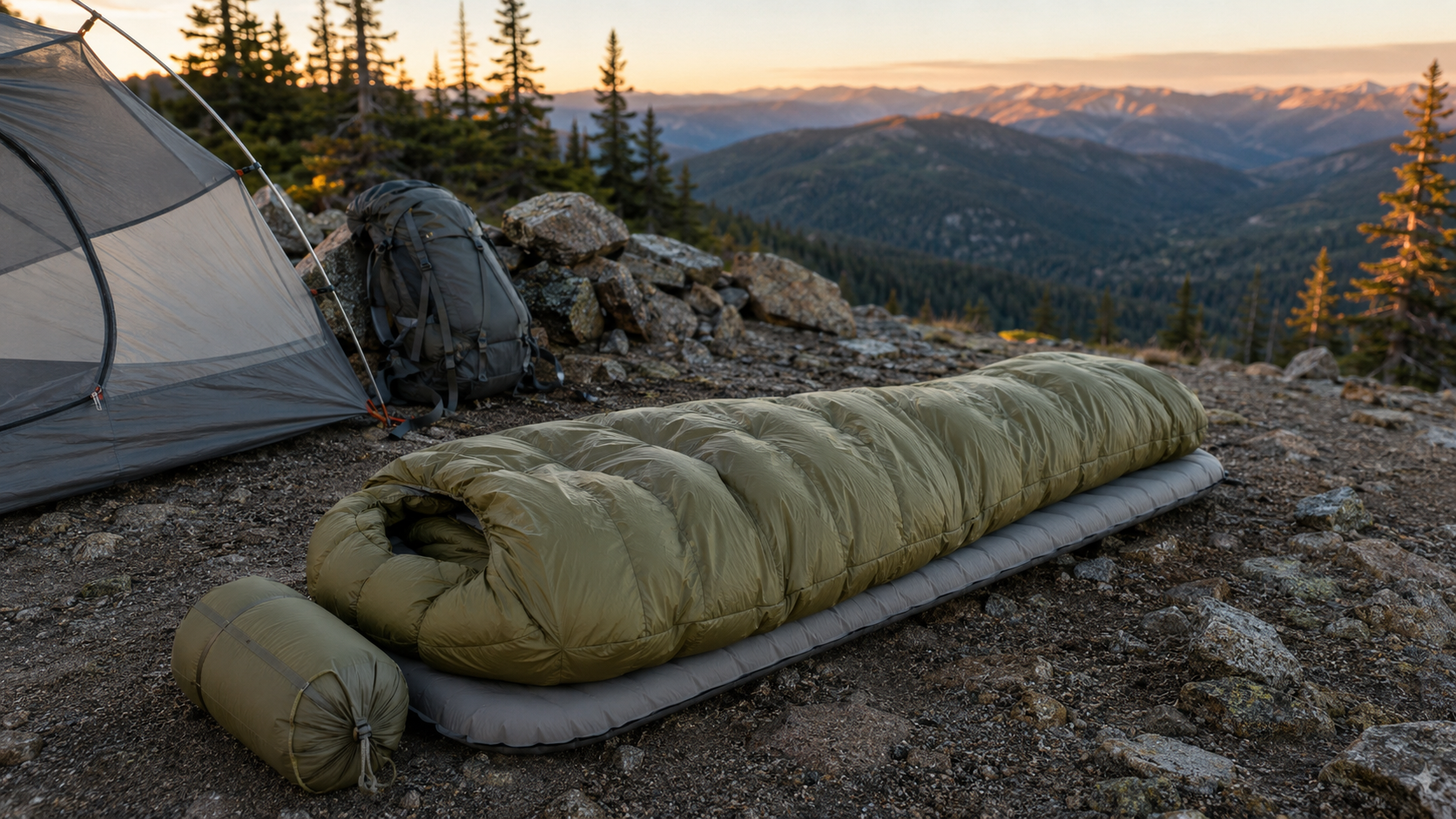
Mummy sleeping bags reduce unused interior volume and can provide a good warmth-to-weight ratio for hiking and compact travel. Wider shoulders, a shaped hood and enough foot-box room can improve comfort without turning the bag into a bulky rectangular model. Buyers should compare the finished pattern, not just the flat dimensions.
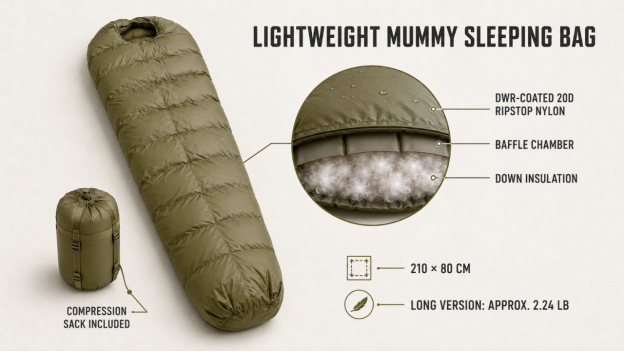
For a current product reference, review KANGO’s lightweight down mummy sleeping bag with compression sack. The page lists a 210 x 80 cm format, a long version at approximately 2.24 lb, a nylon outer, a skin-friendly pongee inner and an included compression sack. It also describes a DWR-coated 20D ripstop nylon construction. Before ordering, the approved specification should fix the final fill species, fill weight, fill power, zipper specification and tested temperature rating.
EDITOR NOTE – IMAGE 2: Insert here after the product example. This graphic explains the construction and confirmed page-level parameters. Remove this note before publishing.
3. Treat water resistance and waterproofing as different claims
A DWR finish can help the shell resist light moisture, condensation and brief contact with damp surfaces. It does not automatically make the complete sleeping bag waterproof. Seams, zipper construction and hydrostatic performance also affect water entry. If a buyer plans to use the word “waterproof,” the quotation and sample approval should identify the test method, required result and whether seams are sealed.
For humid or wet markets, moisture management may be more useful than an aggressive waterproof claim. Consider a fast-drying liner, shell treatment, breathable storage bag and clear drying instructions. A sleeping bag should also be used with an appropriate tent, bivy or shelter rather than presented as a complete weather barrier.
4. Verify temperature ratings before using cold-weather keywords
Marketplace keywords such as “extreme cold weather” or “-30 degree sleeping bag” can attract traffic, but they should never be copied onto a different model without supporting test evidence. Fill type alone does not establish performance. Fill weight, loft distribution, baffle design, size, hood and draft control all influence the result.
For adult sports and leisure sleeping bags, buyers can ask whether testing and labelling follow a recognized method such as ISO 23537-1:2022. The standard covers thermal, mass and dimensional requirements for adult bags with limit temperatures of -20 C and higher; it excludes military-specific, extreme-expedition and children’s products. The quotation should identify the exact test method and report number rather than simply saying “tested.”
When ratings are supplied, make sure the product page clearly separates comfort, limit and extreme values. The extreme value is not a normal comfort recommendation. Retail instructions should also explain that clothing, sleeping mats, humidity, wind, shelter and individual metabolism can change the user’s experience.
5. Compare down and synthetic insulation by market need
Down insulation is attractive for lightweight backpacking because it can offer high loft and compact packing. However, buyers still need the fill species, fill power, fill weight and distribution by baffle. Those details should match across the product page, sample label, test report, quotation and purchase order.
Synthetic insulation may be a better fit for price-sensitive programs or prolonged damp conditions because it can be easier to dry and may retain more practical insulation after moisture exposure. It is usually bulkier for the same target warmth. A regional range can therefore include a compact down model and a separate synthetic model instead of forcing one construction into every climate and price point.
6. Configure products for the U.S. market
- • Lightweight backpacking SKU: prioritize verified weight, packed dimensions, a compression sack and an efficient mummy pattern.
- • General camping SKU: allow more shoulder and foot room, use a durable shell and balance comfort with an accessible retail price.
- • Cold-condition SKU: use a separately tested insulation package, hood and draft control rather than changing only the product title.
- • Packaging: show Fahrenheit and Celsius, pounds and kilograms, inches and centimeters, user height guidance, care instructions and the exact contents of the package.
- • Andes and high-altitude travel: prioritize a validated lower temperature rating, effective hood coverage, draft control and a sleeping-mat recommendation.
- • Patagonia and southern, windy zones: emphasize shell durability, DWR performance, moisture management and compatibility with a suitable shelter or bivy.
- • Tropical and coastal markets: consider lower fill weight, ventilation, a quick-dry lining and compact packing for warm-weather camping.
- • Localization: use metric units and prepare Spanish copy for relevant markets and Portuguese copy for Brazil; confirm care symbols, importer details and packaging requirements with the local customer.
7. Configure products for South American markets
EDITOR NOTE – IMAGE 3: Insert here after the U.S. and South America configuration sections. It shows the full sleeping bag, compact packed volume and the insulation filling directly, without labels or extra props. Remove this note before publishing.
8. Confirm size, weight and packed volume on the approved sample
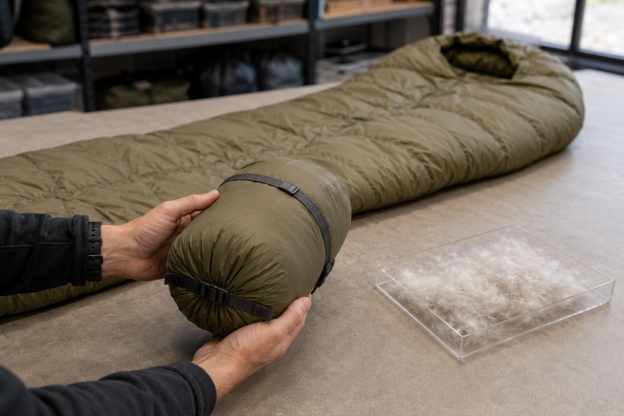
A nominal length and width do not tell the whole story. Measure the finished bag at the shoulder, hip and foot box, then record the recommended user height. If a long version is intended for users up to 6 ft 6 in, confirm that claim with a finished sample and a defined measurement method.
Weight should be recorded for the complete sale unit and, if useful, for the sleeping bag alone. Packed dimensions should be measured with the production compression sack and normal packing pressure. Buyers should also specify whether the shipping carton may compress the insulation for an extended period and how the product should recover its loft after unpacking.
9. Build a complete quotation specification
A useful request for quotation gives the supplier enough information to quote the same product the buyer actually intends to sell. Include:
- • Target country, climate, season and end-user activity.
- • Required comfort or limit temperature and the accepted test method.
- • Mummy or rectangular shape, finished dimensions and user height range.
- • Down or synthetic fill, species if applicable, fill power, fill weight and baffle plan.
- • Shell and lining materials, fabric weight, DWR requirement, colors and zipper details.
- • Maximum finished weight, packed dimensions and compression-sack construction.
- • Quantity by size and color, target price, packaging, barcode and language requirements.
- • Sample approval process, inspection standard, test documents and bulk tolerance limits.
10. Evaluate the supplier beyond the first sample
The first sample proves only that one unit can be made. Bulk reliability depends on incoming material control, fill-weight consistency, baffle filling, stitching, zipper installation, final measurements and packing. Ask how the supplier records insulation lots, controls finished weight and handles deviations during production.
For private-label or custom sleeping bags, freeze a signed specification sheet and approved sample before mass production. The inspection checklist should use the same terms as the sales page so that marketing, purchasing and quality control are working from one version of the truth.
Conclusion
The best sleeping bag program for the United States and South America is not one universal model. It is a focused range built around verified temperature performance, the right insulation, realistic water-resistance claims, clear sizing and market-appropriate packaging. Buyers can explore KANGO’s sleeping bag collection and wider camping and survival products. To discuss a target climate, specification, sample or wholesale project, contact the KANGO team with the intended market, quantity and performance requirements.
Frequently Asked Questions
What is the best sleeping bag for the U.S. and South American markets?
There is no single best model for both regions. Select by climate, altitude, humidity, season, activity, user size, verified temperature rating and price point. A small range of clearly differentiated SKUs is usually safer than one product with very broad claims.
Is a down sleeping bag always better than a synthetic one?
No. Down is attractive when low weight and small packed volume are priorities. Synthetic insulation may be more practical for damp conditions, faster drying or lower target prices. The correct choice depends on the product brief.
What should a sleeping bag temperature label include?
It should state the test method and clearly separate any comfort, limit and extreme values. The model, size and insulation tested should match the product being sold, and users should receive guidance about mats, clothing and shelter.
Can sleeping bags be customized for wholesale orders?
Colors, shell and lining fabrics, insulation package, labels, logos, packaging and accessories may be customizable depending on supplier capability, minimum quantity and testing requirements. Confirm every change on an approved sample and specification.
What should a buyer send to request a quotation?
Provide the target country and climate, activity, temperature requirement, shape, dimensions, fill type, target weight, quantity, color split, packaging, language, testing requirement, target price and requested delivery window.
Post time: Jul-24-2026