
A practical guide to construction, moisture claims, packed volume, compatibility and customization for professional buyers.
A poncho liner—often called a woobie blanket—is a simple piece of field gear, but its performance depends on details that are easy to overlook. Shell fabric, insulation, quilting, tie cords, packed volume and moisture resistance all influence whether the product works as a camp blanket, poncho liner, emergency wrap or compact sleeping layer.
For distributors, outdoor brands and institutional buyers, the goal is not to choose the thickest product. The better approach is to define the target climate and use case first, then approve a construction that balances warmth, weight, durability and packability.
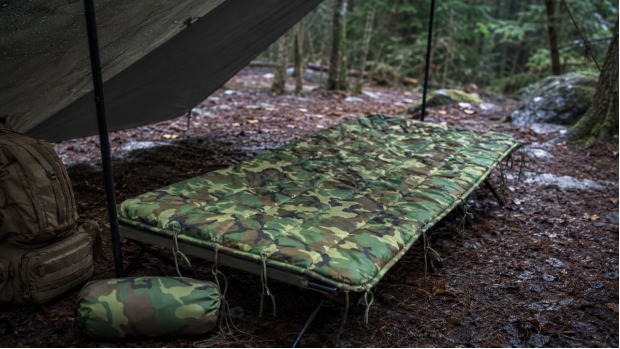
1. Understand What a Poncho Liner Is Designed to Do
A poncho liner is best understood as a lightweight insulated layer rather than a conventional sleeping bag. Depending on the construction and attachment points, it can be used as a blanket, protective cover, ground layer, improvised sleep wrap or liner attached to a compatible rain poncho.
This versatility is useful for camping, hunting, field work, emergency preparedness and vehicle kits. It also means buyers should avoid evaluating the product with only one question such as “How warm is it?” A complete specification must define how the liner will be carried, attached, cleaned and used in the field.
| Buyer takeaway: Treat the poncho liner as a multi-use insulated textile system. Define its primary and secondary uses before choosing materials or dimensions. |
2. Compare Shell Fabric and Insulation Construction
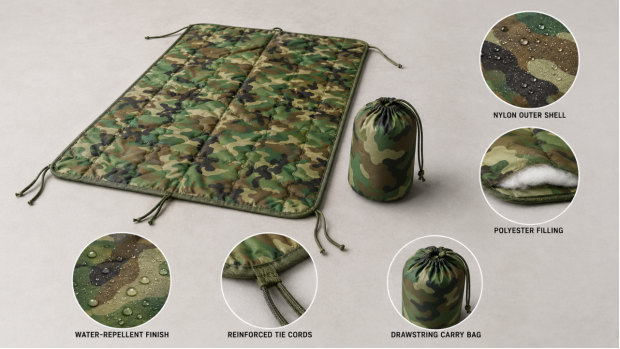
The outer shell should resist abrasion while remaining light and easy to compress. Nylon is a common choice because it provides a practical balance of strength, low weight and quick drying. The insulation layer is usually polyester batting or another synthetic fill selected for loft, recovery and washability.
KANGO’s wet-weather poncho liner woobie uses a nylon outer shell with polyester filling and includes a drawstring carry bag. The product is positioned as lightweight and water repellent, with tie cords for attachment to a compatible poncho. These details provide a useful starting point, but a wholesale specification should also confirm fabric weight, coating, fill weight, quilting pattern and stitching standard.
During sample review, check the following:
l Whether the fill is evenly distributed across the full liner.
l Whether quilting prevents insulation from shifting or forming cold spots.
l Whether shell fabric shows puckering, needle damage or coating marks.
l Whether the liner recovers its loft after being compressed in the carry bag.
l Whether edge binding and corner seams remain flat under light tension.
3. Treat Water Repellency and Waterproofing as Different Claims
Water-repellent fabric can resist light rain, condensation and brief contact with damp surfaces. It does not automatically make the complete poncho liner waterproof. Stitching holes, open edges, tie points and unsealed seams can still allow water to enter.
For accurate marketing, use “water repellent” only when the fabric or finished product has been reviewed against an agreed test method. Avoid claims such as “100% waterproof” unless the complete construction—including seams—has supporting test results.
4. Check the Tie-Cord and Poncho Compatibility System
Tie cords turn a quilted blanket into a more flexible field component. They can help secure the liner to a compatible poncho, anchor it as a temporary cover or keep it positioned around a user. Poorly placed or weak ties, however, can tear away from the shell.
A bulk-order specification should define:
- · The number and exact position of tie cords.
- · Cord material, length, color and minimum strength.
- · Reinforcement method at each attachment point.
- · Compatibility with the buyer’s poncho dimensions and eyelet layout.
- · Whether the cords must be removable, replaceable or permanently sewn.
Do not assume that every poncho liner fits every poncho. Ask the supplier to confirm compatibility from a drawing or physical sample before production.
5. Evaluate Size, Weight and Packed Volume Together
A large liner offers more coverage, but it may also require more fabric and filling, increasing weight and packed size. A smaller, lighter version is easier to carry but may provide less coverage as a blanket or sleep wrap. These factors should be evaluated as one system rather than as separate selling points.
The current KANGO product reference is approximately 2 lb and includes a drawstring carry bag. Because product-page dimensions may vary between artwork and written details, wholesale orders should use the approved sample and final technical specification as the controlling reference.
| Specification rule: Record flat dimensions, finished weight, packed dimensions and carry-bag dimensions on the same approved sheet. Include an agreed production tolerance for each measurement. |
6. Match the Product Configuration to the Target Market
A single construction may not suit every market. Outdoor retailers may prefer softer fabrics, compact packaging and consumer-friendly colors. Hunting and field-equipment channels may prioritize subdued camouflage, reinforced tie points and abrasion resistance. Emergency and institutional buyers may value easy cleaning, simple labeling and consistent production more than decorative features.
When reviewing the poncho liner collection, divide the range by use scenario rather than listing every version under one broad product name. Useful segments include lightweight camping, hunting and field use, emergency preparedness, vehicle kits and promotional outdoor programs.
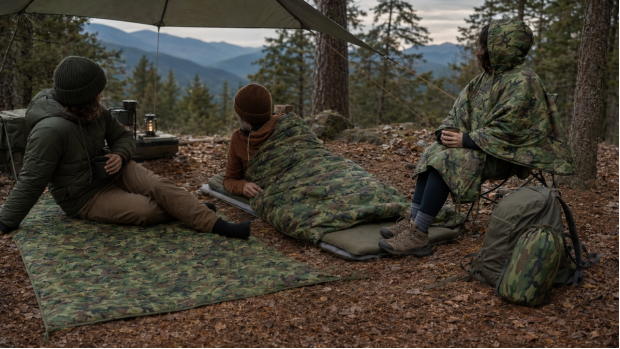
The same liner can also be presented in several practical configurations: spread flat as a ground mat, wrapped around the body as a compact sleep layer, or draped as a loose hooded field wrap. It should not be described as a tailored hoodie unless the product has a true wearable cut, sleeves and closure system.
7. Plan Customization Before Sampling
Customization can improve market fit, but it should be treated as an engineering and quality-control decision—not only as a color choice. Changes to shell fabric, coating, filling or quilting can affect warmth, weight, hand feel and packed volume.
Common wholesale customization items include:
- · Solid colors, woodland patterns or buyer-supplied camouflage artwork.
- · Outer-shell fabric, coating and hand-feel requirements.
- · Insulation type, fill weight and quilting layout.
- · Tie-cord positions, reinforcement patches and edge binding.
- · Woven labels, care labels, barcodes, warning labels and packaging.
- · Carry-bag size, printed logo and carton configuration.
Before approving a custom sample, request a specification sheet that links each material and measurement to a sample reference. This reduces ambiguity when the order moves from development to mass production.
8. Use a Wholesale Quality-Control Checklist
A pre-production sample and final inspection should cover both appearance and functional construction:
- · Approved color or camouflage pattern and print alignment.
- · Flat dimensions, finished weight and packed volume.
- · Shell composition, fill material and fill distribution.
- · Quilting consistency, seam quality and edge binding.
- · Tie-cord count, placement and attachment reinforcement.
- · Water-repellent finish according to the agreed test method.
- · Carry bag, labels, packaging and carton markings.
- · Odor, stains, loose threads, sharp components and contamination.
For repeat programs, retain an approved reference sample and a signed specification sheet. Visual approval alone is not enough when weight, coating or internal filling can change without an obvious difference in photographs.
9. What Information Should Buyers Provide for a Quotation?
A complete inquiry helps the supplier quote the correct construction and reduces repeated clarification. Buyers should provide:
- · Target market and primary use scenario.
- · Estimated order quantity and expected reorder plan.
- · Required flat size, weight range and packed-volume target.
- · Preferred shell material, color or camouflage artwork.
- · Insulation type or required warmth level.
- · Tie-cord layout and compatible poncho reference.
- · Logo, labeling, packaging and carton requirements.
- · Required tests, inspection standard and delivery destination.
Conclusion
A reliable poncho liner woobie blanket is defined by balanced construction, not by one dramatic claim. Buyers should compare shell durability, insulation distribution, moisture performance, tie-cord reinforcement, packed volume and production consistency before confirming an order.
For a current product reference, view the wet-weather poncho liner woobie. To discuss materials, camouflage patterns, packaging or sample requirements, contact the KANGO team with your target market, quantity and preferred specification.
Frequently Asked Questions
Is a poncho liner the same as a sleeping bag?
No. A poncho liner is normally an open insulated blanket or liner. It can be used as an improvised sleep wrap or attached to a compatible poncho, but it does not automatically provide the enclosed construction, temperature rating or draft control of a conventional sleeping bag.
Is a woobie blanket waterproof?
Not necessarily. A water-repellent shell can resist light moisture, but seams and tie points may not be sealed. Waterproof claims should be supported by an agreed test method for the complete product.
Can colors, camouflage and packaging be customized?
Yes, subject to material availability, artwork approval, minimum order quantity and sample confirmation. Any change to fabric or filling should be checked because it can affect weight, warmth and packability.
What should buyers check in a poncho liner sample?
Check dimensions, weight, packed size, fill distribution, quilting, seam quality, tie-cord reinforcement, water-repellent performance, labels, carry bag and compatibility with the intended poncho.
Source and Claim Notes
Product references used for this article: KANGO Wet Weather Poncho Liner Woobie product page and the corresponding Alibaba listing supplied by the publisher. Final published specifications and claims should be checked against the approved sample, signed specification sheet and available test reports.
Post time: Jul-29-2026